Review of the book "What is Artificial Intelligence" from the Primeiros Passos Publisher
<!-- Published on 10/13/2025 -->
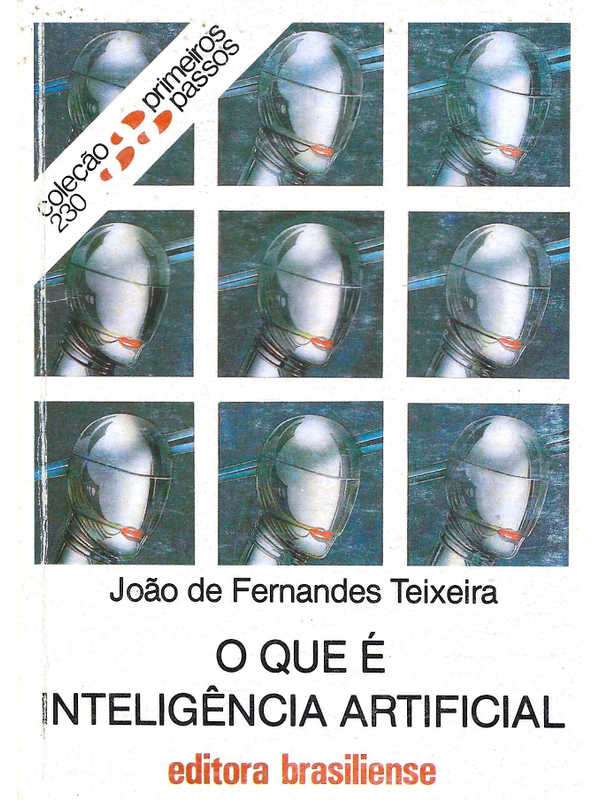
The book "What is Artificial Intelligence" by writer João Fernandes Teixeira explains, through philosophical and computational sources, the dilemmas involved in the use of artificial intelligences, also exploring more technical themes, such as the operational basis of computers. All of this in a small book from the Coleção Primeiros Passos published by Editora Brasiliense.
Right in the introduction, the author explains that for Artificial Intelligence researchers, the human mind works like a computer, and that is why the study of such a mechanism is so important for understanding human activities. In this chapter, examples are used to illustrate the author's expectations regarding artificial intelligences. João Fernandes Teixeira, for example, seems enthusiastic when saying that for linguistics, AI could become a universal translation machine, containing the fundamental root of all languages. Today, one can say the author was correct, given the ease with which LLMs (short for Large Language Models) can process human languages, and even other languages, such as machine languages and the "languages" used by animals. For this and other reasons, it is necessary to remember the context in which the book was written: still in the last century, when AI models were not so advanced, nor so well-known by the general public.
In the next chapter, entitled "A Little History and Story", the author provides a historical foundation for AI, stating that the idea of building a thinking machine or an artificial creature that imitates human abilities is very old. The legend of Joseph Golem, the myth of the mechanical flutist, and "Vaucanson's duck" are examples of ideas from past centuries that support the concept of a creator being autonomous, capable of acting on its own without human intervention. Descartes (1596-1650) and La Mettrie (1709-1751) were both philosophers who wrote on this theme, the former known for arguing that it would be impossible to create an automaton equal to human beings; La Mettrie argued the opposite. One way or another, even today, there is still no clear answer to this question, after all, humanity has not yet been able to create anything beyond a predictable and unconscious algorithm. That is why the idea of an AI with truly autonomous and conscious mechanisms is only a reality in the world of fiction, exemplified by the famous character Frankenstein, from Mary Shelley's novel. After other mentions of characters, events, and historical figures, the author concludes the chapter.
Next, in the chapter "Turing's Invention", João Fernandes Teixeira introduces a more technical writing style, focused mainly on the computational aspect of Artificial Intelligences. In this part of the book, we have explanations that summarize the essential mechanisms for the functioning of computers, all based on the studies of scientist Alan Turing, considered the father of computer science. During the explanation, it is stated that Alan Turing probably committed suicide because of his homosexuality. But this is not necessarily true, as it was not Turing's sexual orientation that directly led him to commit suicide, but rather the prejudice and discrimination that resulted from Alan having come out as homosexual. This correction is important so that the idea of someone being "homosexual" is not associated with misfortune or a disastrous fact.
The chapter "Artificial Intelligence and Philosophy" begins by recounting the case of a lecture in London, where a philosophy professor, while defending his theory that mind and brain are the same thing, received the following question from a student: "But, professor, if mind and brain are the same thing, and if we know that almost 50 percent of the brain is composed of water, then are you saying that many of our thoughts are nothing more than water? And if so, why does the water in the brain 'think' and the water in the body 'does not think'?". With this question, many other inquiries and even suppositions can be made; and during this chapter, some of them are explored to relate the theme with artificial intelligence. It is known that AI, even today, does not have the capacity to think for itself. In fact, what current models are capable of is relating data, performing calculations, and identifying patterns, unable to approach what could be called consciousness. Therefore, the idea of software being called intelligent is still debatable; it is more plausible to relate the word intelligence to the cognitive capacity of its creators and the reasoning of those who wrote the material used for the AI's training. In this chapter, the question of the materiality of the human brain is also discussed, and it is important to remember that even years after this book was written, the theme remains under discussion.
In "The Enigma of Meaning", it is explained that the creation of AI can replicate visual capacity and certain aspects of human linguistic activity, but still has considerable limitations in other aspects. The American philosopher John Searle expresses his idea of a mechanical and non-autonomous AI through the Chinese Room argument. With it, he seeks to say that AI does not properly understand what it is doing, it only uses a pre-established method to give answers consistent with what is demanded. Much like a television camera merely reproduces images that will be interpreted by humans, and does not exactly "see" what is being recorded.
Finally, in "Conclusion", the author explains that the goal for research advances in the field of AI is not to create new beings similar to humans, but to use its technology to better understand the functioning of the human mind. This conclusion is still debatable, especially since there are still no computers capable of simulating human consciousness (also called "soul" by some). João Fernandes Teixeira says that "betting on the success or failure of the AI project in the coming decades is something that depends on the degree of optimism we wish to have". Today, in the second decade of the 21st century, artificial intelligences are widely used by the population, mainly for repetitive activities that can be reproduced by intensive data processing, and it remains a doubt whether in the future artificial intelligences will have capacity equivalent to humans in terms of autonomy and creativity.
Despite the era in which it was written, the book contains explanations and arguments that are still very valid, creating genuine reflections regarding the use of AI, being a great read for all who wish to understand a little more about the subject.